











Summer doldrums arrived for global financial markets in the third quarter as the combined pressures of rising interest rates, ongoing Mideast conflict, and persistent inflation worked to slow robust gains from earlier in the year.
For the three months ended September 30, broad U.S stocks, as measured by the Russell 3000 Index, rose 1.4%; the S&P 500 gained 2.5%; and small U.S. companies did an about face, declining over 6%. International developed stocks climbed 0.9% and emerging markets stagnated, declining 0.4%. U.S. bond prices fell 3.5% as interest rates broadly rose. Gold prices rose slightly for the quarter, ending at $4,157 per ounce.
SOURCE: Dimensional Fund Advisors US Stock Market (Russell 3000 Index), International Developed Stocks (MSCI World ex USA Index [net div.]), Emerging Markets (MSCI Emerging Markets Index [net div.]), Global Real Estate (S&P Global REIT Index [net div.]), US Bond Market (Bloomberg Barclays US Aggregate Bond Index), and Global Bond Market ex US (Bloomberg Barclays Global Aggregate ex-USD Bond Index [hedged to USD]) Past performance is no guarantee of future returns.
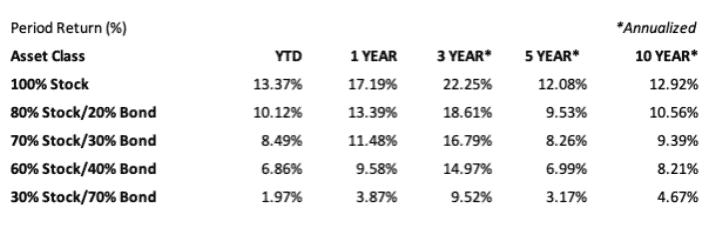
**Indices used for hypothetical portfolios returns are the MSCI ACWI for equities and the BBgBarc US Agg Bond for fixed income. All data derived from Morningstar Office. Past performance is no guarantee of future returns.
Arriving near the end of the quarter, the Federal Reserve put an exclamation point on interest rate moves by hiking the Fed Funds rate 25 basis points (one-quarter of one percent) on September 16 to a new range of 3.75–4.0%. This was the first hike since September 2023 and acknowledged what was obvious to most: inflation is remaining stubbornly above the Fed’s 2% target. While new Chair Kevin Warsh carried the weight of the White House that appointed him pushing for lower rates, he forged a consensus displaying the historical Fed independence, and the vote to raise rates was a unanimous 12–0. Two meetings remain in 2026: October and December. Voting members indicated in their minutes a median projection of one more hike before year end. Framing that outlook, futures markets are assigning a 25% probability for another hike in October, and a 65% probability for December.
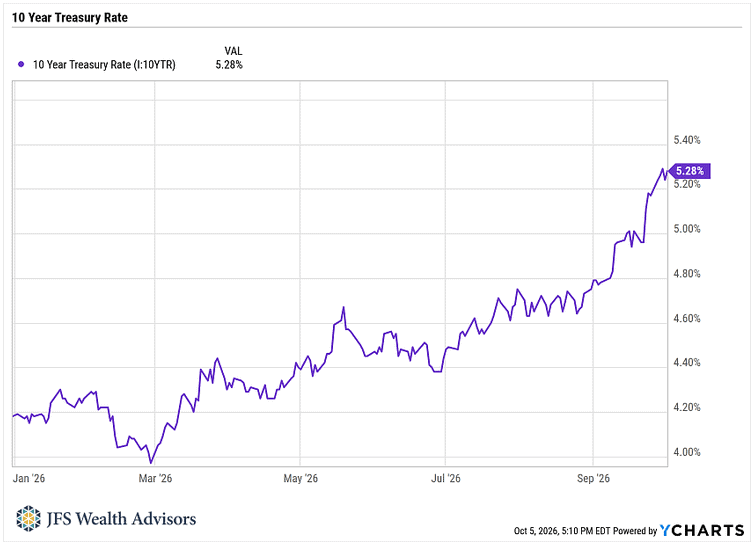
While the Fed raised its benchmark by 0.25%, the bond market has reacted far more vigorously. In the face of commodity inflation as well as consumer demand signals, the 10-year US Treasury bond, a bellwether measuring stick across the world, has risen approximately 1.15% (115 bps) since the beginning of 2026 (chart below). Breaking through the 5% yield is a psychologically important event, and at these levels not seen since 2002, seismic tremors have gone through global bond markets, while shakes are hitting stocks. Burgeoning debt levels in the US and across major global economies add another twist to this story, as financial markets demand higher rates to hold government debt, and the cost of debt service inexorably climbs. It is a worrisome mix, although far from new. Yet, as we note below, economies have still exhibited strength in the face of these higher rates. And as we note further along in this commentary, rising rates are not all bad; there are important investment silver linings.
Economist Milton Friedman is generally attributed with labeling inflation as “too much money chasing too few goods,” describing demand-driven price pressures. While that remains a truism, today’s situation is multi-pronged and more than just the classic consumer-driven demand during a booming economy. Shocks are difficult for a central bank to incorporate in their planning, because by their nature, unexpected events chart far less predictable paths. Culprits today include tariffs, turmoil in the Mideast, and surprisingly robust labor markets. Let’s take a quick look at each.
Tariffs
We’ve written about this in previous commentaries, but historically tariffs are harmful to global trade and economies. Since the onset of “Liberation Day” in April 2025, global trade has been significantly disrupted, with traditional alliances shattered and new ones forming. While the Supreme Court subsequently struck down the bulk of the reciprocal tariffs, things are far from returning to where they were, and the current administration shows little desire to mend fences. A recent quote from an anonymous manufacturing executive in the latest ISM manufacturing report sums it up well: “Every month, we are faced with new headwinds created by this administration. This month, it is the trade war with Canada, which every day is getting worse—causing prices to go up and uncertainty that creates massive disruption. Buying continues to get pushed out indefinitely as customers don’t want to spend on capital expenditures until there is more certainty of costs and demand. The only thing that is predictable is the chaos that is created by these trade policies.”
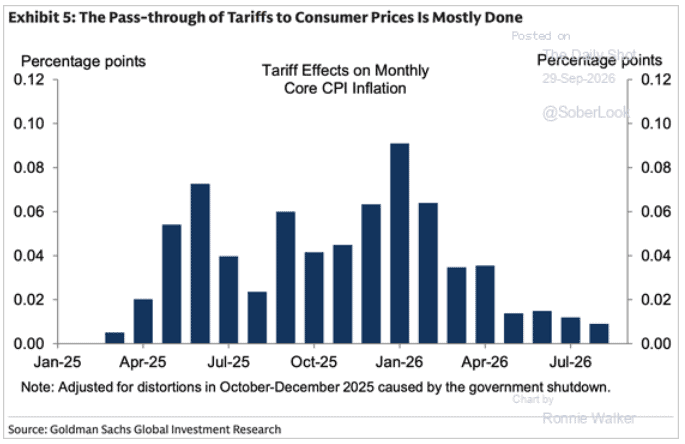
The chart below reflects the inflationary impacts of the tariffs, shown as a monthly measure. The good news is that the impact is declining precipitously. The less-than-good news is that many of these impacts have been passed through to consumers and resulted in sticky higher prices. In other words, we’re in a more permanent environment of elevated prices.
The Mideast
Impacts from the hostilities with Iran are well-known and ongoing; disruptions to global petroleum supplies have been severe. At this writing there are glimmers of good news, namely that oil traffic through the Strait of Hormuz has climbed to some 80% of pre-war flows (although accuracy is always in question). However, that is easily disrupted with a resumption of strikes on ships, and the additional chokepoint of the Bab al-Mandeb Strait now controlled by the Iran-backed Houthis means the path to unimpeded passage for crude oil to markets is far from clear. Also positive is the reopening of Saudi Arabia’s East-West pipeline after being damaged in multiple strikes, but that, too, is a tenuous link. And, at this writing, as a third US carrier group heads to the region, a quick resolution seems unlikely.
Headlining the impacts of the conflict have been gasoline and diesel prices. The Climate Solutions Lab at Brown University has tracked the extra fuel costs to US consumers from a pre-war baseline and calculates that gasoline prices, up 45%, have cost $69.6 billion, and diesel, up 72%, have cost $57 billion, with figures climbing daily. We cite this not to be political, but to highlight the very real pocketbook impacts Americans are seeing for a daily life necessity.
A final point : oil at or above $100/bbl ripples prices pressures across industries and products. Agriculture, shipping, construction, packaging, automobiles—it’s hard to find an industry that is unaffected and not causing pricing pain to consumers. We can hope the war ends and these effects prove to have been temporary, but for now, seven months in, they seem far from transitory, and the Federal Reserve must account for the inflation pressures this war is causing.
The Economy
Driven in large part by the incredible build-out of artificial intelligence infrastructure, the US economy is powering through these choppy seas. The most recent GDP data reflects an estimate of 2.2% annualized growth rate in the third quarter, and while job gains slowed to 29,000 in September, the unemployment rate of 4.2% is historically low. Companies may not be hiring at a fast clip, but neither are they letting workers go. New order and manufacturing data point to this strength continuing in September, and while this is indeed good news, it’s a “good news is bad” picture when it comes to interest rates. As an ISM analysis put it, “With employment beating estimates, regional activity expanding briskly, and GDP accelerating, inflation risks could easily resurface heading into the final quarter.” This description is much more the textbook inflation Friedman speaks of, and the Fed is paying close attention.
The fly in this strong employment ointment is wage growth, which, at 3%, is lagging inflation, with CPI most recently 3.4% year over year. This means that workers are falling behind in real spending terms, a trend that could, sooner or later, lead to less spending and more saving. We already see consumer confidence declining to a level surpassing the COVID-era lows: likely a harbinger of a weaker consumer environment.
AI
We would be remiss to overlook the AI elephant in the room. Stephanie Aliaga, JP Morgan analyst, spoke on our most recent webcast, and painted a nuanced picture of the AI boom and buildout. Pushback is rising as questions surface around data centers, energy usage, safety and control of AI models, and whether sustainable profits will follow the immense spending cycle underway. Yet all signs suggest this is not a flash-in-the-pan event. Unlike the 2000 dotcom bubble, most of the AI leaders are cash-generating and profitable, and AI is working its way into daily use around the world. Further, in a sign of vast potential ahead, only 20% of companies surveyed said they were formally utilizing AI in the workplace, with most still exploring it. An interesting perspective Ms. Aliaga shared is shown below in our final chart, which measures in years how long a new technology takes to arrive at a 75% usage rate. Over the years, the pace of adoption for significant, life-altering technology has accelerated dramatically, from decades to just a handful of years. And as the chart shows, AI leads that pace, fast injecting itself into seemingly everything. Love it or hate it, AI appears here to stay, and the impact on economies and financial markets is, and will continue to be, significant.
IMG
The Road Ahead
How to think about the period ahead? The fourth quarter is historically a positive period for stocks, and Truist Bank CIO Keith Lerner notes that 84% of midterm election years since 1950 have shown positive Q4 returns. That’s encouraging of course, but, with signs of narrow market leadership, we believe that continuing to diversify beyond solely US large cap is desirable. About ¾ of US stocks saw price declines in the third quarter, so prudently holding international exposure with lower valuation multiples and higher dividends remains attractive. In addition, any decline in the dollar will just add to the tailwind of lower valuations.
What about bonds, facing the headwinds of higher interest rates? Bonds are not for everyone, and it’s important to understand that their portfolio role is a volatility buffer and income producer, not a return chaser. So, while bond prices are down for the year, yields at these levels suggest bonds are attractive and can add inflation-beating income to a portfolio. This may seem like a counterintuitive stance, but higher yield means higher income to spend or reinvest, and while prices have suffered in the climb to get here, history tells us this will not last forever. Higher yields provide a bigger portfolio cushion should stocks falter, and the historically low or negative correlation of bonds to stocks (-0.03 over the past year) similarly suggests a cushioning benefit around price movements as well.
All that said, every client circumstance is unique, and portfolio allocations can be tailored to match goals and objectives. Reach out to your JFS team with questions and/or to review your plan and portfolio.
On behalf of all of us, we wish you a healthy fall and a thankful spirit heading into the holiday season. Your confidence is valued and appreciated.